Market frictions

Why the system fails

Congestion, information asymmetry, and weak coordination create lost opportunities for both candidates and departments.

01

Congestion

Offers cluster; some positions remain unfilled.

02

Noisy interest

Difficult to identify sincere interest.

03

Coordination failure

Departments may miss out on ideal candidates.

04

Resource waste

Interview slots go to candidates unlikely to accept.

Overview

A preference-signaling layer for academic hiring that keeps disclosure credible and informs interview decisions.

Structured preference signaling

Candidates complete one standardized questionnaire. Departments evaluate fit using a shared structured signal instead of cover-letter interpretation.

Signal credibility

  • Single submission format makes signals comparable across departments
  • Scarcity prevents costless customization per department
  • Continuous scores support market-wide inference
What changes

Candidates express structured preferences once and disclose the signal to selected departments.

Selection rule

Departments combine signals with traditional materials using confidence-calibrated ranking.

Market-level effect

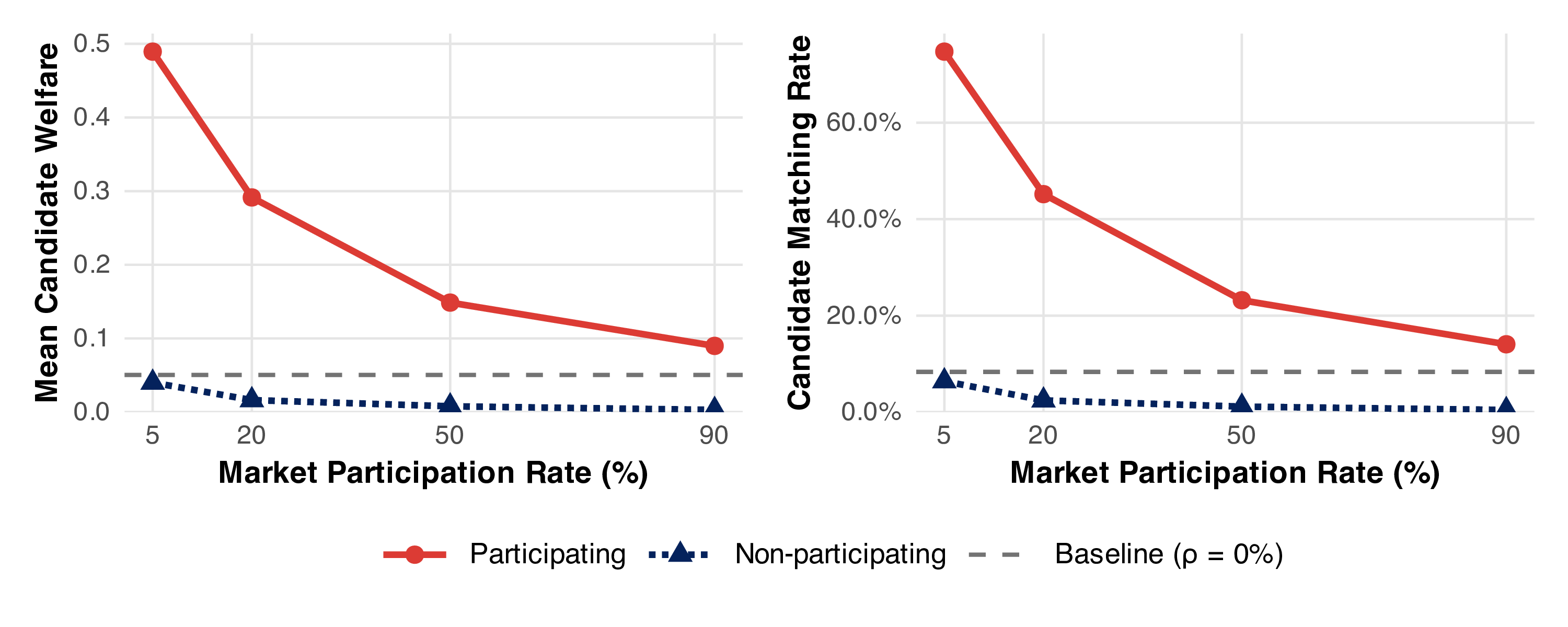
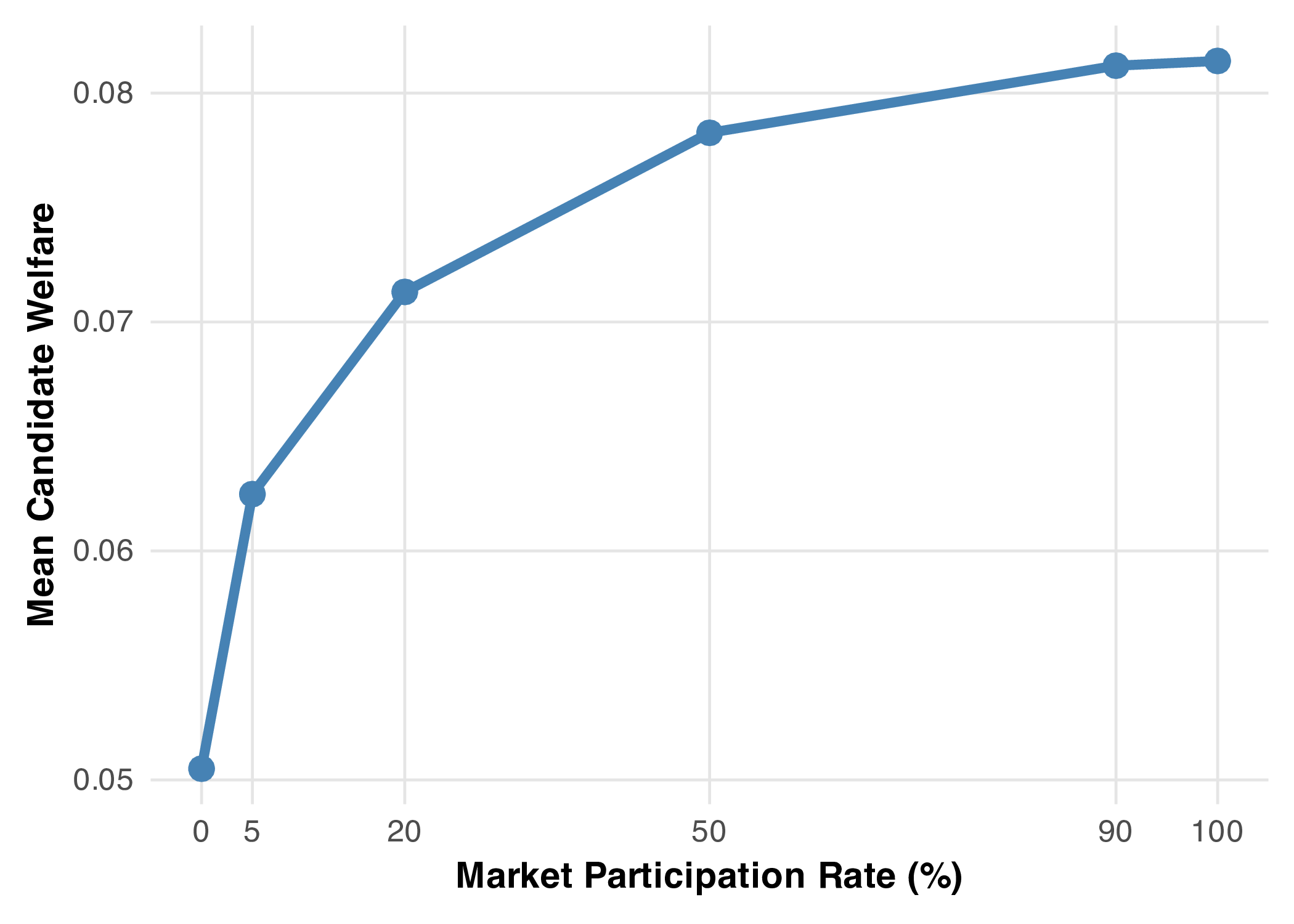
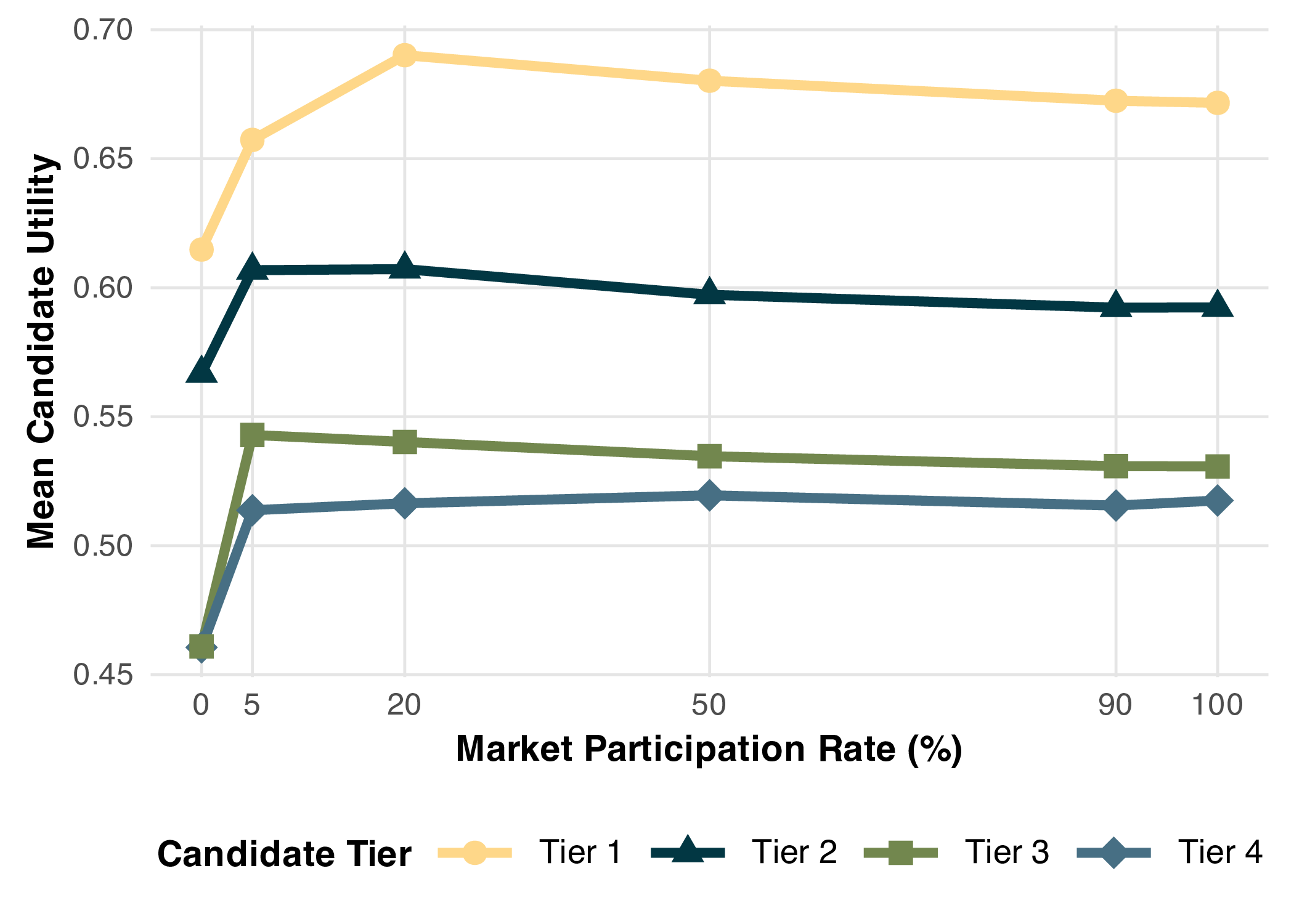
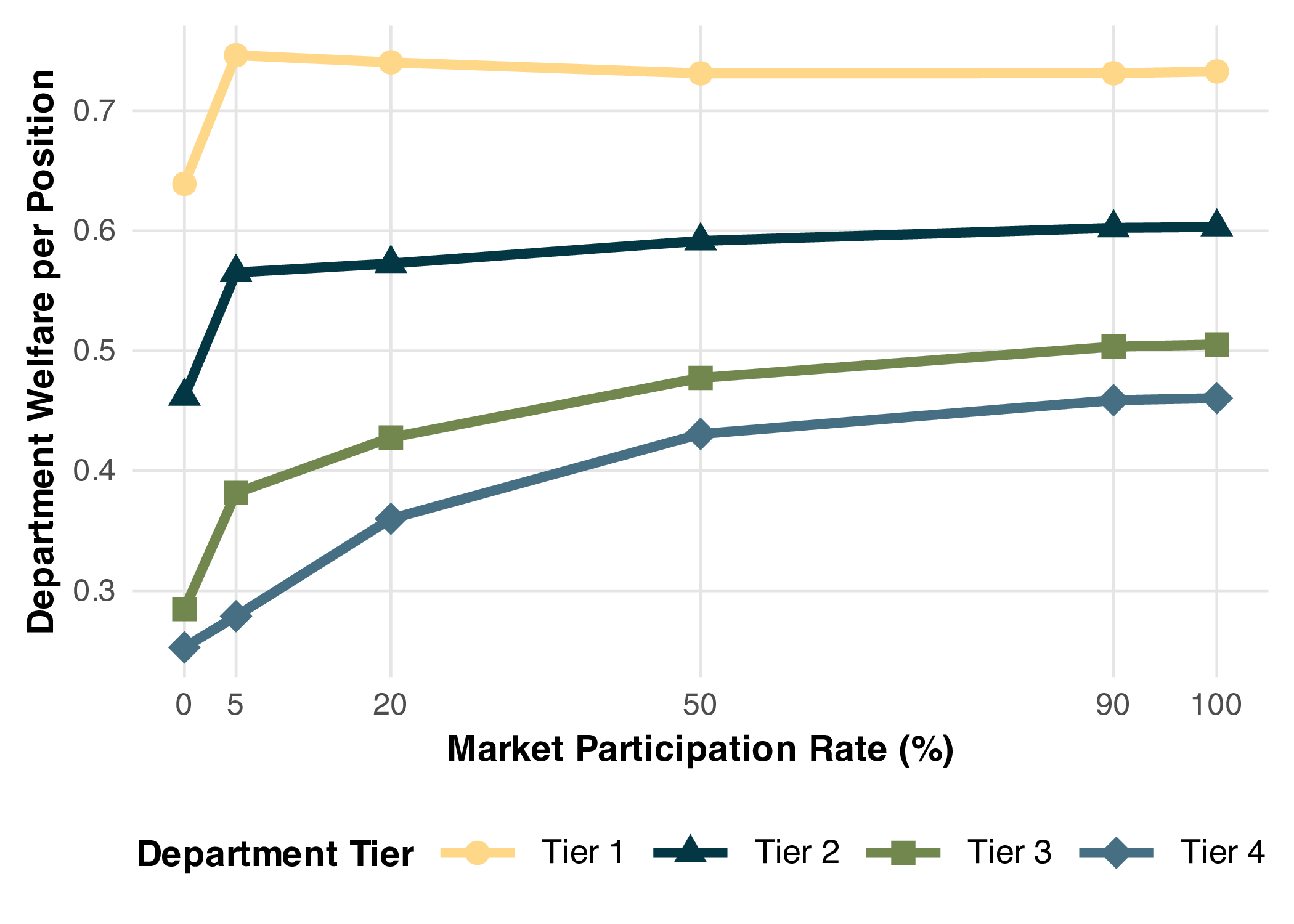
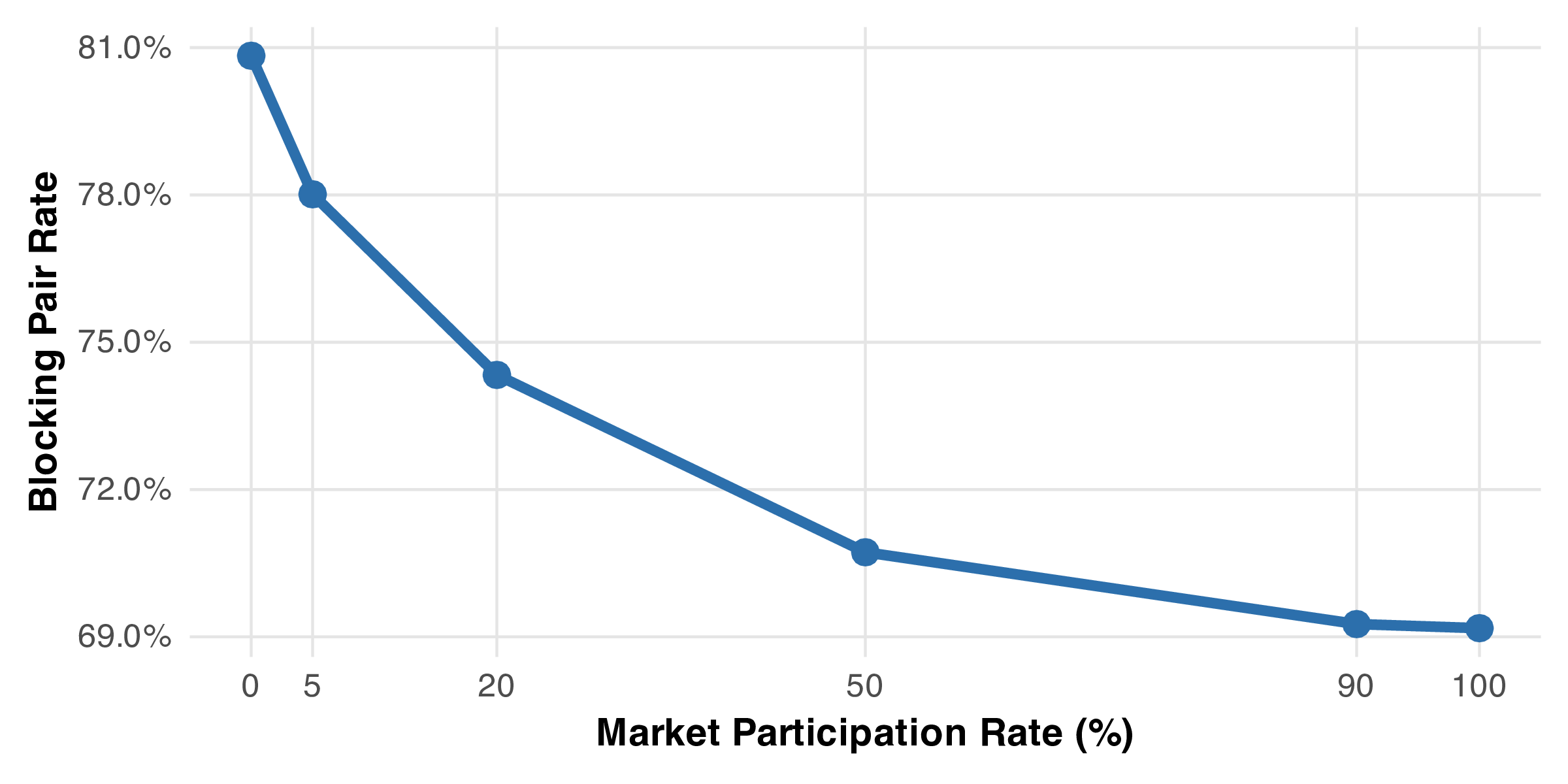
Welfare and fill rates increase with participation; universal disclosure is a dominant strategy.

Without signaling

Volume overwhelms information

  • Genuine interest indistinguishable from strategic applications
  • Interview slots consumed by low-probability candidates
  • Offer concentration leaves positions unfilled

With signaling

Preference data informs interviews

  • Candidates communicate fit in a standardized format
  • Interview decisions incorporate estimated acceptance probabilities
  • Better shortlists raise match quality and fill rates

Mechanism

Three-stage design

Adds a structured preference layer before interviews, then uses uncertainty-aware ranking to guide interview invitations.

1

Signaling stage

Candidates complete one questionnaire

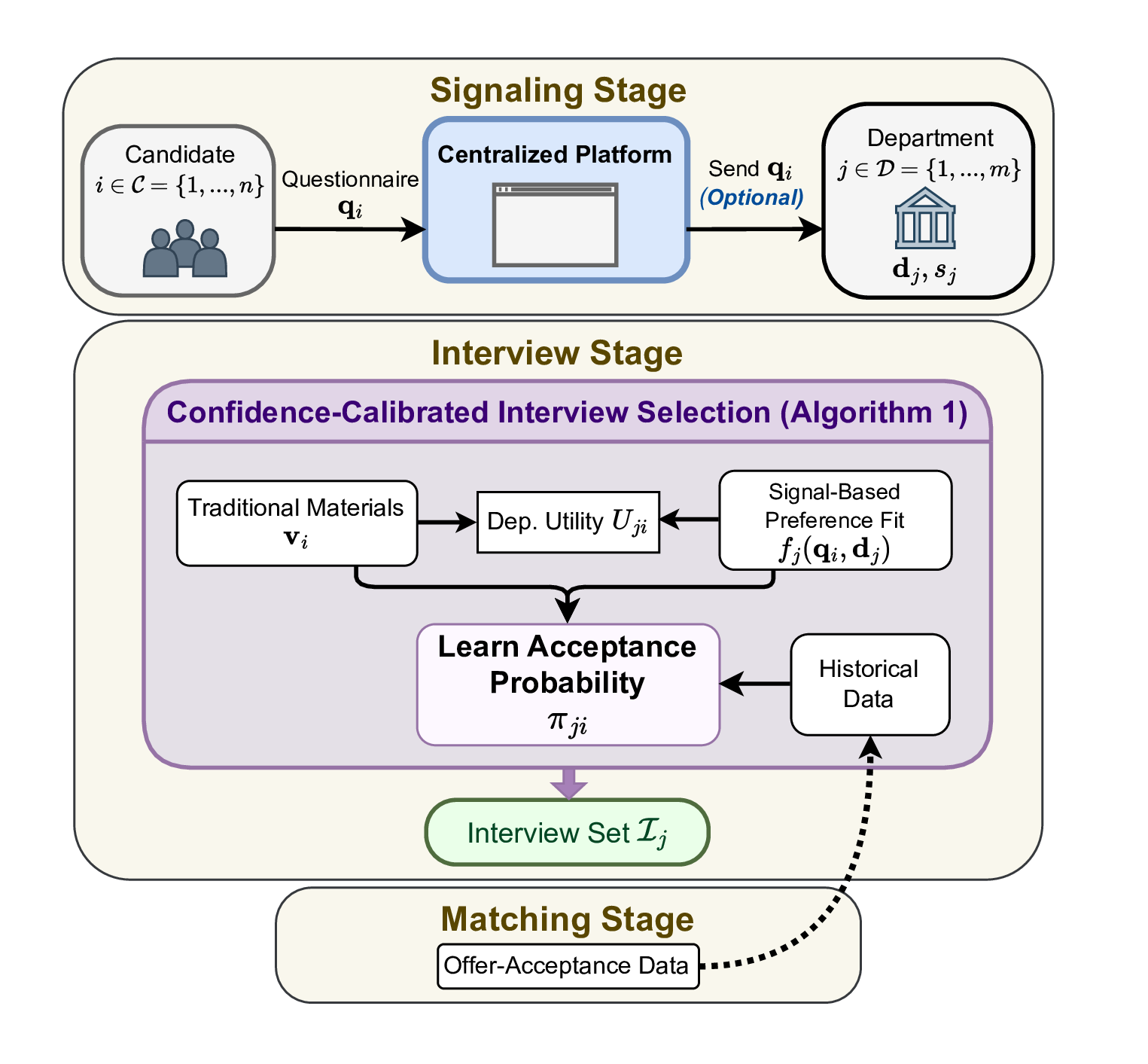
A standardized questionnaire captures job preferences. Candidates choose which departments receive it alongside traditional materials.

2

Interview stage

Departments rank with calibrated confidence

Signals are combined with traditional materials to estimate acceptance probabilities and select interviewees via simultaneous pairwise comparisons.

3

Matching stage

Standard offers, sharper information

Departments extend offers as usual, but the market operates on better information and moves closer to stable outcomes.

Overview of the signaling, interview, and matching stages in the proposed market-design framework.
Process map Figure 1. The questionnaire enters the pipeline before interview selection and feeds the confidence-calibrated ranking procedure.

Joint uncertainty control for shortlist selection

Simultaneous pairwise comparisons ensure the shortlist contains the top candidates with high probability—not just those with the most optimistic point estimates.

Results

Incentive guarantees and simulation evidence

Mechanism-design guarantees combined with simulations grounded in data from 101 U.S. statistics departments.

Theoretical guarantees

Truthful participation is a dominant strategy

  • Universal disclosure dominates for candidates
  • Misreporting incentives vanish under market competition
  • Aggregate welfare is nondecreasing in participation
  • Better information pushes toward stable outcomes

Simulation design

Empirical scaffold from real departments

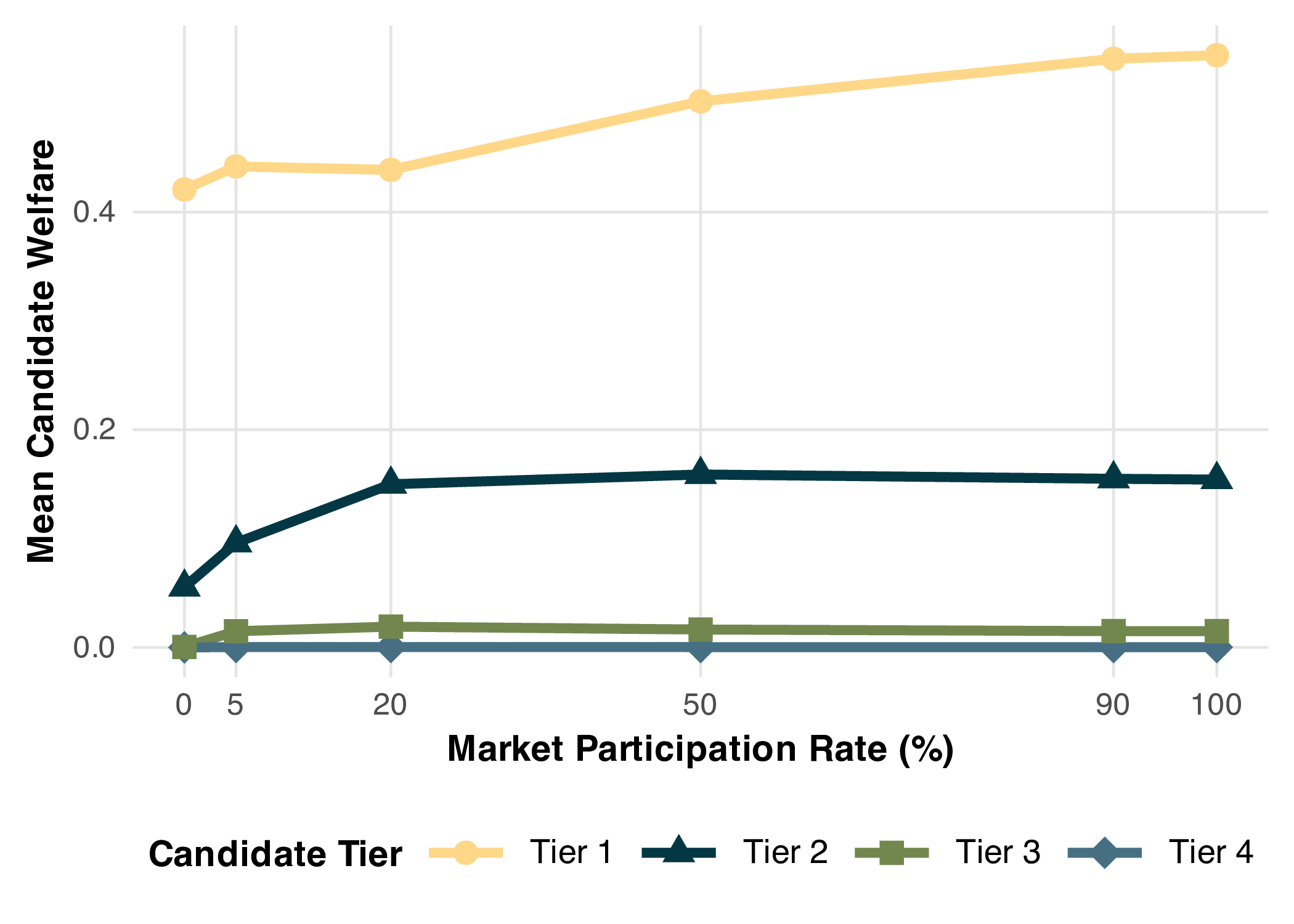
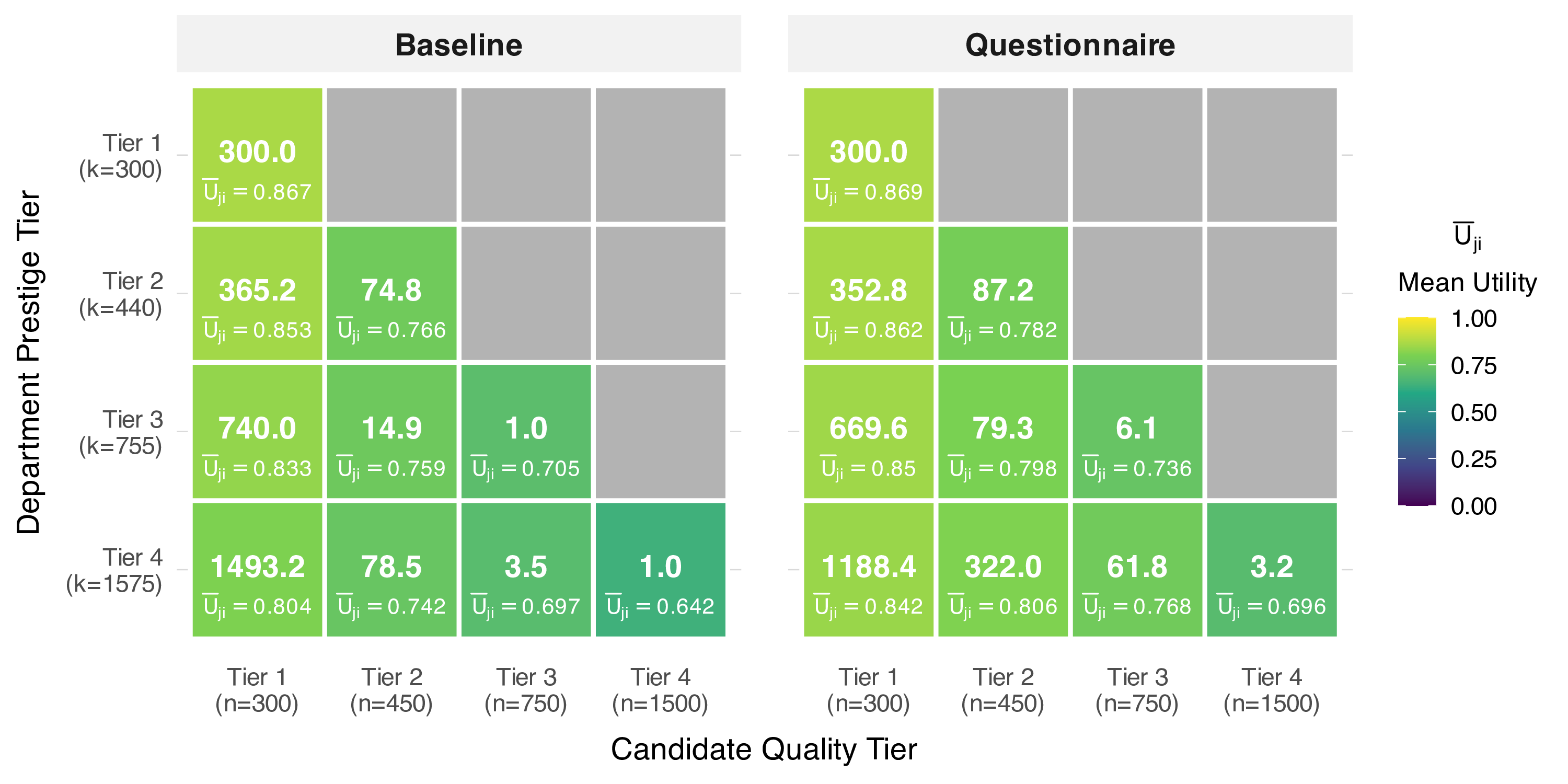
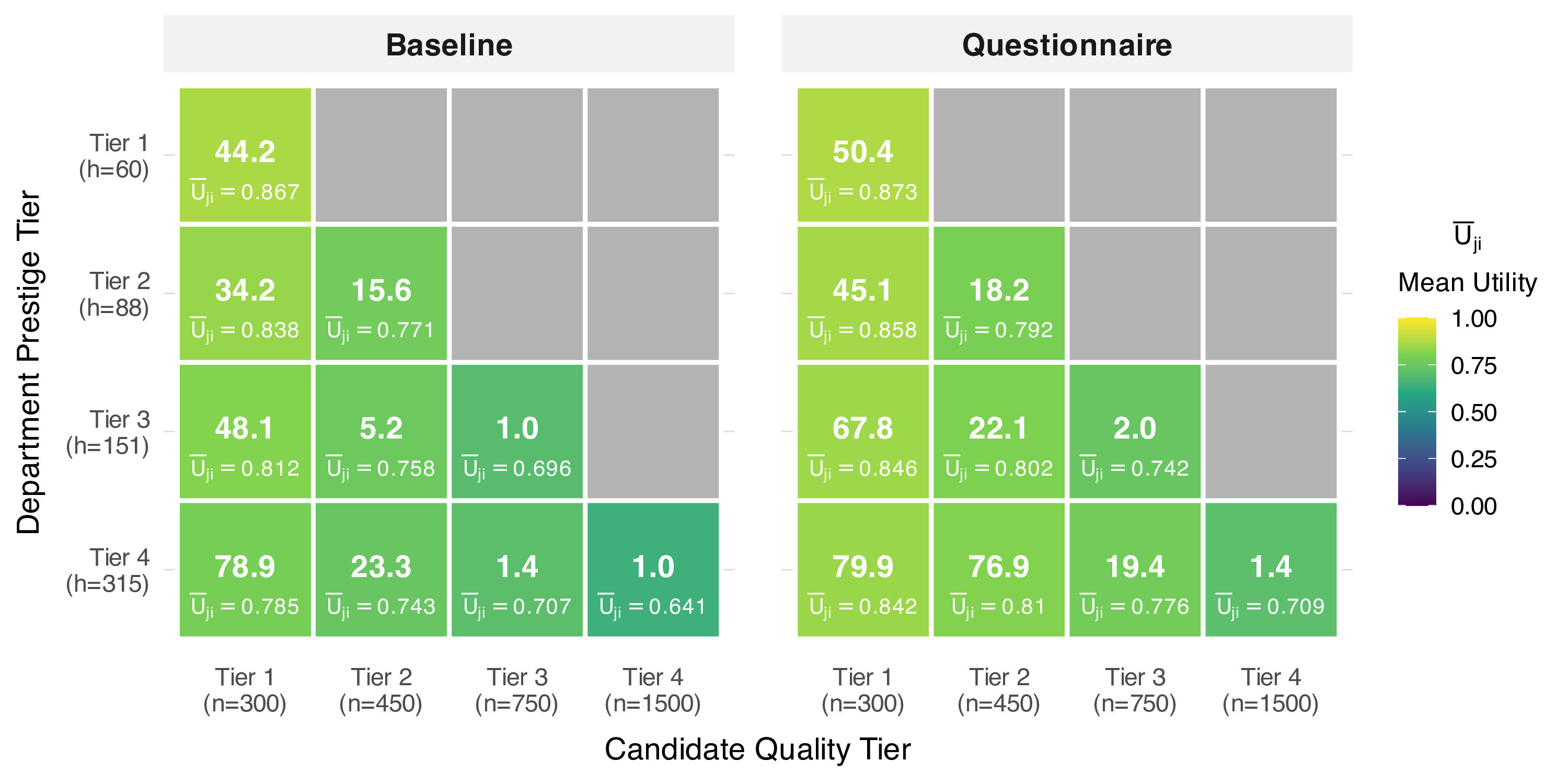
Simulations merge U.S. News rankings with College Scorecard data across 101 departments in four prestige tiers.

300 candidates/year, 10-year horizon, 200 replications. Participation rates ρ ∈ {0%, 5%, 20%, 50%, 90%, 100%} tested.

Example questionnaire

Questionnaire

A market-wide comparable signal

The questionnaire covers dimensions central to academic job decisions. Potential questions may include:

Geography and place

  • Urban or rural preference
  • Regional priorities
  • Airport proximity
  • Cost-of-living sensitivity
  • Partner placement support

Compensation and resources

  • Salary floor expectations
  • Research startup needs
  • Summer salary support
  • Research budget priorities

Teaching and mentoring

  • Preferred teaching load
  • Graduate or undergraduate emphasis
  • Mentoring structure
  • Faculty development support

Research environment

  • Departmental research culture
  • Publication ecosystem
  • PhD pipeline strength
  • Medical-school proximity
  • Collaboration expectations
<

Design principles

Design principles

Standardized enough to compare candidates fairly, broad enough to reveal meaningful preferences.

Single submission preserves credibility
Same dimensions for every department
Continuous scores enable market-wide ranking
No department-specific tailoring

Paper and repository

BibTeX
@article{academicmarket2026,
  title={A Statistical Market-Design Framework
         for Academic Job Markets},
  author={Kaazempur-Mofrad, Ali and
          Dai, Xiaowu and He, Xuming},
  year={2026}
}