Market frictions

Why the system fails

Congestion, information asymmetry, and weak coordination create lost opportunities for both candidates and departments.

01

Congestion

Offers cluster; some positions remain unfilled.

02

Noisy interest

Difficult to identify sincere interest.

03

Coordination failure

Departments may miss out on ideal candidates.

04

Resource waste

Interview slots go to candidates unlikely to accept.

Proposed mechanism

Three-stage design

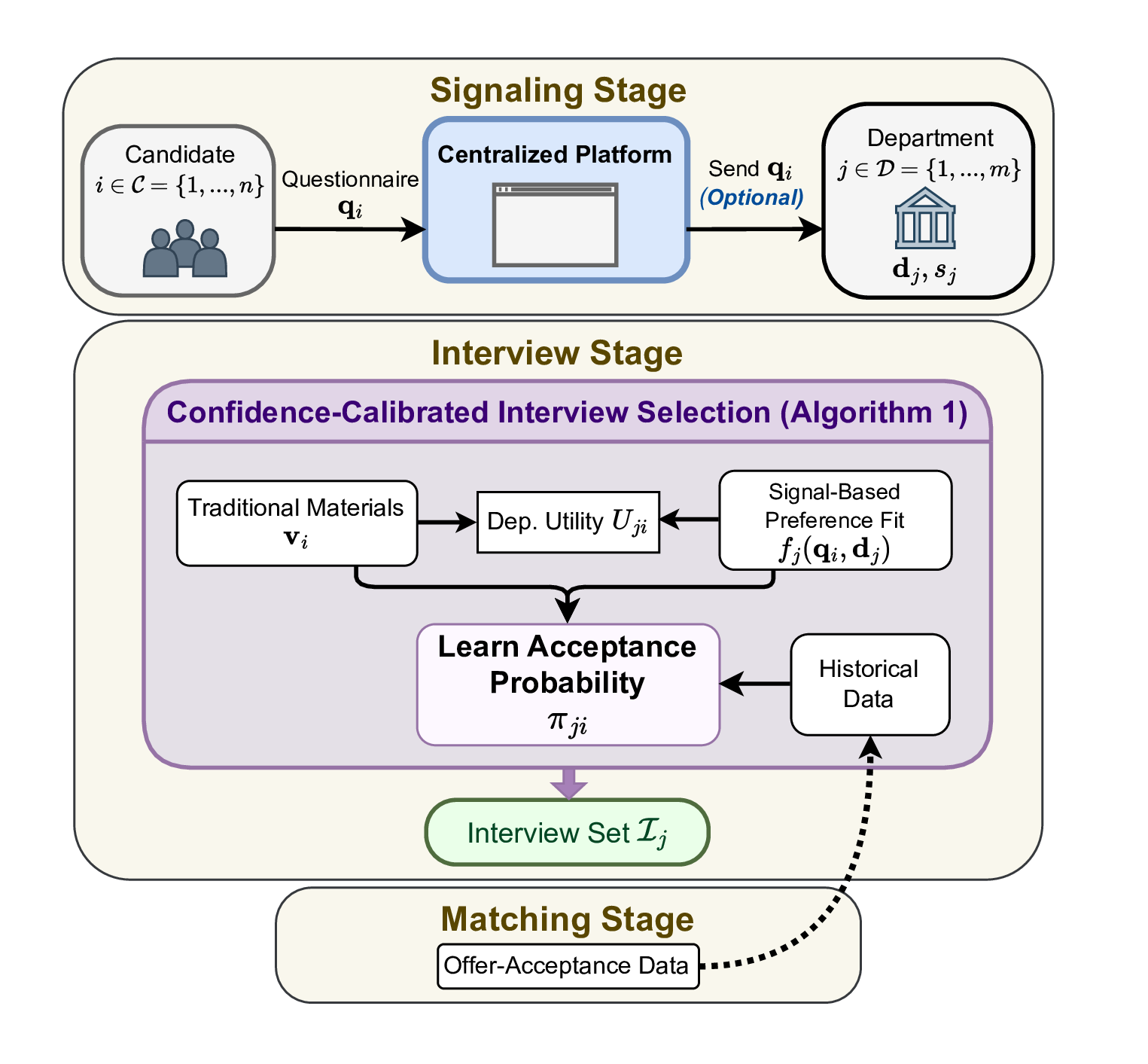
A preference-signaling layer for academic hiring: candidates complete a single questionnaire and departments use the resulting signals to inform interview decisions.

1

Signaling stage

Candidates complete one questionnaire

A standardized questionnaire captures candidate preferences, and each candidate selects which departments receive their responses.

2

Interview stage

Departments rank with calibrated confidence

Questionnaire signals are combined with traditional materials to estimate acceptance probabilities and inform interview selection.

3

Matching stage

Standard offers, sharper information

Departments extend offers as usual, but more informed decisions move the market closer to stable outcomes.

Overview of the signaling, interview, and matching stages in the proposed market-design framework.
Process map

Results

Incentive guarantees and simulation evidence

Theoretical guarantees

Truthful participation is a dominant strategy

  • Universal disclosure dominates for candidates
  • Misreporting incentives vanish under market competition
  • Aggregate welfare is nondecreasing in participation
  • Better information pushes toward stable outcomes

Simulation design

Empirical scaffold from real departments

Simulations merge 2026 U.S. News rankings with College Scorecard data across 103 departments in four prestige tiers.

300 candidates/year, 10-year horizon, 200 replications. Participation rates ρ ∈ {0%, 5%, 20%, 50%, 90%, 100%} tested.

Questionnaire

A market-wide comparable signal

The questionnaire covers dimensions central to academic job decisions.

Potential questionnaire categories

Location
Compensation and resources
Teaching
Research environment

Example questionnaire Open in new tab
Loading two-page preview...

Paper and Code